Monday, September 17, 2012

An Ordinary Week

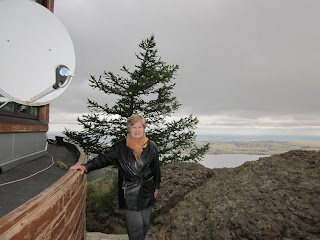
A rainy day in Yekaterinburg

Although I may be mistaken, it looks like this is going to be a rather ordinary week.  I'm not dealing with hallucinations from jet lag, and I am settled in here in Yekaterinburg.

There are some housekeeping matters to attend to.  Slava keeps the place pretty clean while he's here, but I've noticed that there are things that still need doing.  I may be sexist, but I don't think that men remember as often as women to empty the crumb tray on a toaster.  Window sills need dusting, and then there's ordinary cooking and cleaning to do.

Tuesday and Wednesday I'm having friends over for tea, and Slava's family will come over for dinner on Friday or Saturday.  I'm scheduled to go back two more times to the agricultural college, although I don't think I did so well the first time.  Thinking that the faculty might want to learn about land grant universities in the United States, I've done some research on how they were set up in 1862 under the first Morrill Land Grant Act, signed into law by President Lincoln.  It should be noted that half the U.S. population at the time lived on farms.

As we were dealing with the consequences of slavery, Russian tsar Alexander II decided to free the serfs, saying, "it is better to liberate the peasants from above than wait until they win their freedom by risings from below."  The Russian nobility was not in a position to oppose this measure, because to maintain their lifestyle and get cash, the nobles had mortgaged an increasing percentage of this human property.  When 23 million serfs became free to leave the property on which they were born, they found their freedom as hollow as did many former slaves did in the U.S. during Reconstruction.

I diverge.  It turns out I won't be talking at the agricultural college about the set up of land grant colleges in the U.S., and I certainly won't be talking about Russian serfdom,  I also won't be talking about the agricultural experiment stations established under the Hatch Act of 1887, which sent cooperative extension agents into rural areas.  I've been asked to talk about international relations.  I'm rather certain this means, "How can we arrange to send someone to the United States?" and "Can we get anyone to come here as a visiting professor?"

Sunday, September 16, 2012

The Cold Comfort of Cynicism

I have some advice for would-be despots, and there always seem to be a few springing up here or there.  If you want to subvert whatever bits of democracy there are in your country, do whatever you can to promote cynicism.

The first step I recommend is to raise small hopes in people -- and then crush them.  No, not the people, just their hopes.  Be ready with a scapegoat or two for the troubles.  External scapegoats are safer to use than internal ones -- remember that people will become angry with those being scapegoated.

The next step is fun but a little dangerous.  You need to put incompetent people in positions of authority, and protect them behind-the-scenes.  You're then ready to make the public feel they're right to be cynical, and this is very important for the following reason:  It promotes passivity, which is just what you need.

Cynical people tend to think of themselves as "realists."  That's okay.  It inocculates them from hope.  If anyone from the outside tries to promote hope, the cynics will actively reject that approach because it doesn't fit their mindview.

  In Time Must Have a Stop, Aldous Huxley has a character say:

           Cynical realism is the intelligent man's best excuse for doing nothing in an intolerable situation.

 A modern despot needs to remember that.  You can't maintain a situation that others would find intolerable unless you make sure that there is a good excuse for them to do nothing about it.  Cynical "realism" does the job.

Religious faith can be a threat to cynicism.  Even when there is no hope for change in the immediate future, a religious person can envision a world different from the existing one.  And a person may move in the direction of the vision.  That must be stopped!  Fortunately, it's fairly easy to do.  Promote hypocrisy.  Buy off religious leaders if you can, or point out some silliness that they do.  Demonstrate hypocrisy yourself.  Pretend to be religous.  Alternatively you can highlight extremism in the name of religion and call for rejection of religious people for that reason.  Deal harshly with any religious minorities; they're the most troublesome because they want a measure of independence. Fortunately dominant groups usually don't mind when only minorities are persecuted. 

You may worry that access to modern media will expose your people to ideas of freedom and responsibility.  Yes, that can be a problem, so do be sure to have some controls on the media.  There are lots of ways of doing this; just look around and see what other despots are doing. State television is your biggest friend.  You get to choose what is shown, and what is said.  The surrealistic looks real that way, and the cynical viewpoint can be reinforced again and again.

If your people wonder if there are genuine benefits to democracy that they are missing, you need to circulate some conspiracy theories about how things in democracies are not really as they seem on the surface. Talk about puppet masters and challenge your people to look for invisible strings that are being pulled.  If you've properly prepared them to be cynical, they'll see malevolence everywhere they look.

Young people seem to be idealistic and optimistic by nature, and of course those traits have to be snipped out.  Use your education system to do this.  Have teacher salaries be as low as possible and show indifference to the concerns of educators.  You want to have in the classroom adults who feel bitter and depressed.  Then make sure that the testing system is one that allows for widespread cheating.  Your young people will feel cynical in no time.

I haven't mentioned corruption.  It's something you want, and the more, the better.  Make sure that it's obvious that you reward loyalty over competence.  You don't need to take much for yourself, because you can command luxuries to honor your position.  You can allow those nearest and dearest to you to start sipping from government troughs as soon as you've loosened the democratic government bonds of  accountability.

Fortunately national governments have pretty much backed away from military conquests to gain territories.  You're fairly safe and don't have to spend a lot on military matters (unless you want to do so), as long as you remember that to stay in power you kill hopes, not people.

Diplomatic endeavors?  Mere hand-wringing.  If you enjoy trips to New York City and Geneva and Brussels and other foreign capitals, then do join the diplomatic circuit.  You may not be invited to all the social parties, but you can give parties for your own friends.

Economic threats?  Sometimes these can cause you pain.  Be sure to look out for them and take steps to protect your family and immediate friends. 

Ah, do I sound cynical?  Just surprised.  I hadn't realized how easy it would be in the 21st century to shrug off the progress of human rights.  But watch out.  Danger to you comes from people inside your country who reject cynicism as an excuse for doing nothing.

Saturday, September 15, 2012

Views of Bashkortostan

The beginning of autumn

Bashkortostan has white birch forests intermingled with dark green pine.  There are trees that I cannot name in either English or Russian, but there is one tree of particular importance here:  the linden.  The linden tree flowers in the spring, and bees produce honey from the nectar of these flowers.  Russians regard Bashkirian honey as about  the finest in the land.

A meadow at the edge of a birch forest

 In winter this meadow will be covered with snow, because it is actually the end of a ski slope.  I looked up, up, up and decided it was a slope I preferred covered with grass.

Lake Bannoe
The photo shown here does not do justice to the dramatic look of the hills behind Lake Bannoe.  The low hills surrounding the lake are golden in bright sun, covered with the grass of summer that has turned yellow.  Behind these hills are higher hills shrouded in purple haze.

A Quiet Day

Although I've enjoyed the sauna in our hotel suite, I can imagine how important it can be for clients who come during the skiing season.  It gets bone-chillingly cold here -- actually, too cold to ski.  It can be -40 degrees Centigrade for a month.  An online calculator tells me that -40 C is... -40 Fahrenheit.  So imagine something about 60 degrees below freezing.

The recommendation was made to me to set the sauna for 50 degrees C, and to stay in it not more than 30 minutes.  Converted to Fahrenheit, that's 122 degrees.  I've found that after taking a shower in the morning, my hair dries really quickly in the sauna.

The enclosure has a reading light, however I've felt it would not be a good idea to bring in the book that I'm reading, Nicholas and Alexandra.  It's an e-pub from the Arlington County library, and reading just a few pages in the sauna would undoubtedly fry my iPad.

Slava had to leave the conference here in Abzakova to fly to Moscow for a meeting in Skolkovo with oil pipeline officials.  I'm semi-on-my-own.  Actually it would be hard to brag about my independence because of the affectionate guardianship I've gotten from Slava's deputy director, who has arranged several outings for me with an English speaking guide.


 One outing was to the Zoopark, the entrance to which is pictured above.  We saw a tiger, a bear, three camels, an ostrich,  an American bison, and rabbbits.  Actually there were more animals than I have space to mention.
 

Thursday, September 13, 2012

Don't Leave Home Without It


A traveler atop Mratkino near Beloretsk

There's always a question about the most essential thing to take on a trip.  In this location a fistful of rubles is useful.  So is a credit card on a Russian bank.  Some people feel that they can't be without their cell phone,  Well, I don't have a cell phone with me.  I do have some rubles.  But in going to the top of Mratkino by cable car, I left something essential to me back at the hotel in Abzakovo -- my iPad.

As readers of this blog may have guessed, we have good wi-fi connection in the remote village of Abzakovo, population 3500.  Two years ago Slava and I were at a resort in the Caucasus with no Internet connection.  We had to walk to town to go to an Internet cafe.  Here I can read email, check the news, write "Travel Tales" and do lots more on my iPad in the comfort of my room.

There are some features that have suprised me in their usefulness.  TWC, the app for The Weather Channel, is perfectly willing to tell me what will happen in Abzakovo tomorrow.  I'm grateful to OverDrive, which lets me download e-books from the public libraries in Fairfax and Arlington Counties.  Hulu.com, however, is of no use.  Its website says, "Sorry, currently our video library can only be watched from within the United States. Hulu is committed to making its content available worldwide. To do so, we must work through a number of legal and business issues, including obtaining international streaming rights. Given the international background of the Hulu team, we have both a professional and personal interest in bringing Hulu to a global audience."  Oh, well.

I asked Maps to find Abzakovo, Russia, and the app responded, "Did you mean Abzakovo, Beloretsky District, or Abzakovo, Baymaksky District, Republic of Bashkortostan?" Uhm, I guessed Beloretsky, and I was right.  It's actually New Abzakovo, built up around a new train station.  The resort facilities are here.  (Poor Old Abzakovo is like tiny towns in the U.S. by-passed by interstate roads.) 

Google Earth is fun.  It's posssible to zero in on the cross streets of Abzakovo or zoom out to see the town in relation to Yekaterinburg (225 miles northeast, on the other side of the Ural Mountains) or in relation to Moscow (840 miles almost directly west).  Unfortunately Google Earth doesn't make it easy for me to capture images and put them here.

Yelp tried and failed to find restaurants near my current location.

iTranslate is not bad.  And Google Translate is powerful. I have not, however, found a Rosetta Stone type app at the price I want to pay, which is nothing.  I might spend a few bucks on a language program that looks really good, but I haven't found that yet.

Spotify gives me a variety of music choices.  Russian radio tends to feature, well, Russian music.  The pop music is not unpleasant; it has more emphasis on melody and rhyme than American pop.  But I like instrumental music as background listening.

TED Talks are a great substitute for television.  The videos are entertaining and more interesting than most TV programs, anyway.

I'm expecting to use BigOven or Epicurious next week when planning a dinner party. I've already decided on zakuski appetizers and on the entree.  Dessert should be something that uses the famous honey from Bashkiria.  It's useful to have big cookbooks on my iPad.  The app recipes might not specify Bashkirian honey, however it's convenient to zip through recipes to find those that contain honey as an ingredient.

I won't bother to say much about the always useful apps such as Mail, Camera, Calendar, Safari, and Skype. There are at least a dozen others I use fairly frequently.

Unfortunately not a lot of Russians are able to experience the utility of an iPad.  I saw one priced in a store and realized that stiff tariffs on various imports make the price sky-high.  Now that Russia is a member of the World Trade Organization, protectionist tariffs are supposed to come down.  But salaries also need to go up.  The iPad I saw in the store cost 21,000 rubles, which is about $670.  The average monthly salary of a teacher as reported for 2005 was 5,500 rubles, or $169.  I don't know what a teacher's salary is today, but I believe it is below the reported 2012 worker average, which is 153,720 rubles annually, less than $4900.  If an iPad would cost you several months' salary, you're not likely to buy it.  On the other hand, there are some Russians with a great deal of disposable income.

Apple is moving ahead with technology, and from here I saw videos on CNN about the release of the iPhone 5.   The product looks great.  Yet I appreciate my iPad more and more. The iPad is Goldilocks' sized, just right for my purposes. When I go on a trip in the future I'll say to myself, "Don't leave home without it."


Wednesday, September 12, 2012

A Big Banquet

Tamada for the party
 Russians sure know how to throw a party.  The banquet table shown above was set for the celebration of the 25th anniversary of the founding of the scientific center set up by Svyatoslav Anatoleyvich, a.k.a. "Slava."  The man shown standing is the party's tamada, which roughly, roughly translates into master of ceremonies.  The ta-ma-DA recognizes people who wish to make a toast, give a tribute, or make a joke. My ability in Russian is just good enough to tell the difference between those three activities and catch a few of the things being said.  Fortunately I was seated between Slava and the young woman shown below, who could help me better understand the goings on.

Civil engineering instructor and a speaker at the conference
A Russian banquet table is set lavishly with platters of zakuski appetizers, bowls of fruit, and various types of drink.  There can be several types of Russian salads, platters of smoked or salted fish, sliced meats, and canapes such as the caviar canapes on the table above.  When everyone is entirely full, the hot food comes.  I noticed last night that the head table was served something different from everyone else (they had scallops of meat; Slava ordered fish for us because it is his preference).  What we would call "the main dish" is not the important part of the meal -- the zakuski table is.  Accordingly dessert is not a big deal, and the fresh fruit on the table served as dessert.

Kudos for the party organizer 


Tuesday, September 11, 2012

The Nightmare Begins

A friendly fella in the woods
I had gone to sleep around midnight without the help of Slava's little white pills.  Going to sleep was easy; staying asleep was not.

Around 3:00 am I awoke with a start, remembering a nightmare I had just had.

I was a stewardess in a large airplane, and Slava was a passenger up front.  In addition to the usual duties of a stewardess there was a passenger who really needed my attention because he was very ill.  He was emaciated, in a coma, and I was sure he was dying of AIDS.  He wouldn't last the trip across the Atlantic.  What to do?

I wrapped this young man in a blanket to keep him warm, sat down beside him, and enfolded him in my arms so that he might feel he was not alone.  He died, however, without ever regaining consciousness.

When the plane landed I was the last to leave.  Slava was nowhere to be found.  He was expecting to see me at home, but I had gotten word of back-to-back assignments, and I desperately wanted to get him the word.  I ran around shouting, "Where's Slava?" and people pointed me in various directions.  The smart thing to do, I thought, was to call his cell phone -- but I didn't have mine with me.  I asked a passer-by if I could borrow her phone, and it turned out that hers was the newly released smallest cell phone in the world -- a phone the size of a book of matches.  It had no buttons and worked by inserting a small card.  I couldn't figure out how to use it, but it didn't really matter because I didn't remember Slava's number (It was just something on speed dial on my absent phone).

Thankfully I saw Slava ahead of me, getting on a bus to take him to his car.  Running fast I caught up, and the driver asked where I was going.  At first I couldn't remember where my car was, but with some efffort I remembered that it was at 15th St.NW and New York Avenue.  The bus driver said it wasn't on his route, but he could tell I was upset and so would drive me there directly.  I was relieved.  My nightmare was over.

I know the source of many elements of this nightmare.  First, the frustration of helplessly dealing with a dying man.  That point was made in the book I was reading earlier in the day, Robert Massie's biography of Nicholas and Alexandra.  Empress Alexandra was much maligned in her lifetime and can be blamed for ignoring all signs that Rasputin was an evil scoundrel; nevertheless I was impressed in reading about her selflessness in nursing Russian soldiers returning from the Great War.

Massie quotes the empress' friend Anna Vyrubova who wrote, "I have seen the Empress of Russia in the operating room...holding ether cones, handling sterilized instruments,...taking from the hands of busy surgeons amputated legs and ams, removing bloody and even vermin-ridden field dressings, enduring all the sights and smells and agonies of the most dreadful of all places, a military hospital in the midst of war."

More mundane anxieties intruded on my mind.  Slava and I will have several separate trips over the next few weeks, and I'm worried about communication.  Having read speculation that the iPhone 5 will be bigger than any predecessor, in my dream state I imagined what the smallest phone might be.  And as my nightmare alerted me, I don't know the number of Slava's cell phone.

I don't think my nightmare was caused by anything I ate.  I might take a sleeping pill tonight, but I think I'll switch to melatonin.  It's worked for me before, and it might be all I need now.  Time will tell...